When parents begin exploring preschool options, one core concern often rises quickly to the surface: “Will my child be academically prepared?”
Many families naturally associate academic rigor with traditional markers like worksheets, memorization, early testing, or heavy amounts of teacher-directed instruction. Because Montessori classrooms look calm, hands-on, and child-led, parents sometimes wonder whether children are being challenged enough.
What many parents do not initially realize is that Montessori education is developing something even more foundational than early academics alone. It is actively building the brain’s executive function.
Understanding executive function in preschoolers helps parents see why a Montessori education is not simply preparation for first grade, it is true preparation for life.
What is Executive Function?
Executive function refers to the core set of mental skills that help us manage daily life. It includes the ability to focus attention, plan and organize tasks, control impulses, follow multi-step directions, and solve problems independently.
Scientists often describe these skills as the brain’s “air traffic control system”, managing the arrivals and departures of information and behavior.
Strong executive function supports lifelong academic success, emotional regulation, and social development. In fact, many researchers now consider executive function to be a much stronger predictor of future success than traditional IQ scores.
This is why brain development in early childhood matters so deeply. The preschool years represent a critical window for building the neural pathways connected to concentration, self-regulation, and adaptability and this is exactly where the Montessori method excels.
Beyond the Pink Tower
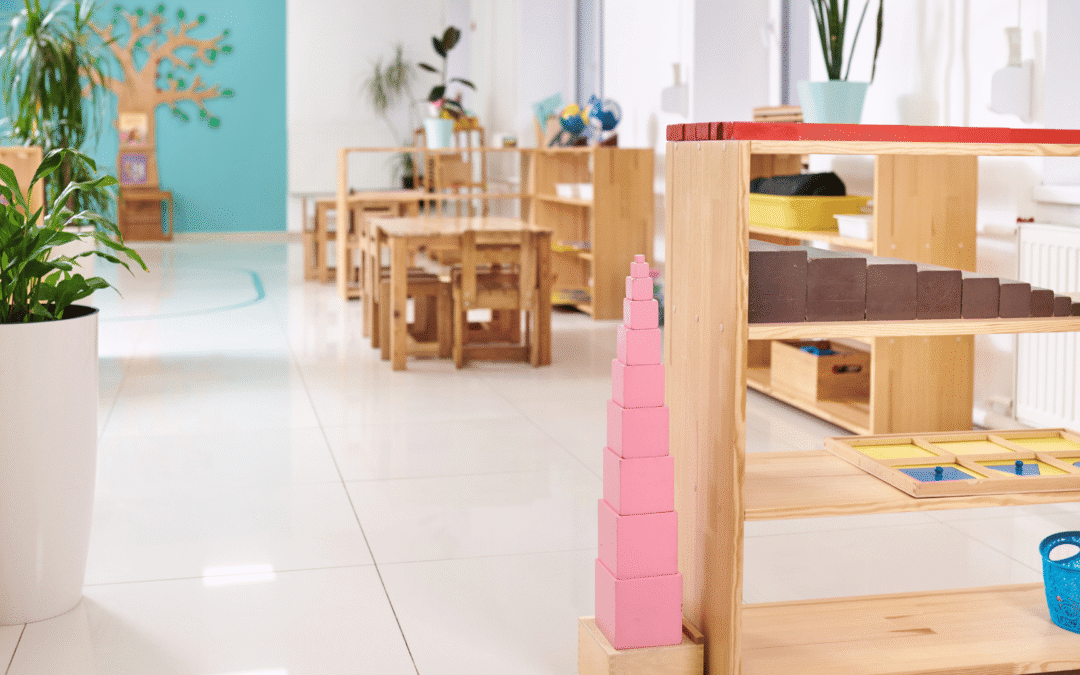
Parents often recognize iconic classroom materials like the Brown Stair, Practical Life dressing frames or the beautiful wooden Pink Tower. While these materials appear elegantly simple, they are intentionally engineered to support cognitive development far beyonf surface-level learning.
A child working with the Pink Tower is not simply stacking cubes by size. They are engaging in structural brain development in early childhood, quietly sharpening:
- Visual discrimination and spatial reasoning
- Fine motor coordination and physical sequencing
- Order, logic, and self-directed error correction
Most importantly, they are practicing sustained attention. This is one of the greatest cognitive benefits of Montessori education. Each material isolates a single concept and invites the child into deep, purposeful engagement. Instead of being rushed from one activity to another, children are encouraged to repeat work until they feel internally satisfied. That deep repetition strengthens the exact neural connections required for focus and perseverance.
The Montessori Work Cycle and Deep Concentration
One of the most powerful yet overlooked elements of Montessori education is the uninterrupted work cycle. In authentic classrooms, children are given extended blocks of time to choose work, explore materials, and follow their concentration naturally.
To families accustomed to highly scheduled traditional programs, this freedom can initially seem unusual. However, these open periods are essential for building lifelong concentration skills in toddlers and preschoolers.
In many traditional preschool settings, children are interrupted frequently by group transitions, whole-class instruction, or timed station rotations. While well-meaning, excessive structural interruption can prevent young minds from reaching deeper levels of focus.
Montessori classrooms intentionally protect concentration. By allowing a child to move naturally through choosing meaningful work, encountering an obstacle, persisting through the difficulty, and experiencing the satisfaction of completion, the work cycle acts like a targeted weight-training workout for executive functioning.
How Montessori Improves Focus and Self-Regulation
One of the most noticeable Montessori academic benefits is the rapid development of self-regulation. Instead of relying on external sticker charts, reward systems, or teacher warnings, children internalize self-discipline through daily practice within a structured environment.
Through the natural boundaries of the classroom community, children gradually learn to manage impulses, wait patiently for a desired material, return items to the shelf properly, and navigate social conflicts peacefully.
Because of this daily practice, parents frequently notice that Montessori children display:
- Remarkably longer attention spans
- Advanced situational independence
- Greater emotional resilience during frustrations
- Confidence when tackling unfamiliar problems
- A Foundation for Life
Montessori education is not focused solely on helping children memorize facts to pass early tests. It is designed to help children become capable, adaptable, and deeply thoughtful human beings.
When children develop concentration, independence, flexibility, and self-regulation during their most formative years, they build an internal framework that supports them forever. They aren’t just learning facts; they are learning how to learn. In today’s rapidly changing world, that is the most valuable educational foundation we can possibly offer them.
Curious about how early brain development takes shape? Join us for our next campus open house to see these incredible skills in action.
